
How to Choose a Gas Grill: Size, Burners & Materials Guide
Cooking area and burner layout decide how a gas grill actually performs — not the BTU number printed on the box. Here is how to size one to your household, your fuel line, and how often you actually cook outside.
Start with cooking area: 300 sq in feeds two people, 500+ sq in supports entertaining for four to six. Pick a burner count with two independent heat zones, choose propane for portability or natural gas for a fixed hookup, then check the stainless-steel grade before the paint finish. That order decides how a gas grill actually cooks.
Most people don’t need a lab report to grill well — they need consistent, repeatable heat for weeknight burgers and grilled vegetables, and enough control to sear a steak on busy weekends. Grilling media has covered this ground for years, but most buying guides lean on brand comparisons and BTU tables. This guide skips both. It focuses on the four measurable factors that decide whether a gas grill performs well on your patio: cooking area, burner configuration, fuel type, and build material — plus a short safety check before you fire it up for the first time.
What Actually Decides Grill Performance (Not Just BTU)
BTU is a fuel-consumption number, not a heat-delivery number. Two grills with identical total BTU ratings can cook very differently depending on how their burners are laid out and how evenly that heat spreads across the grate.
A BTU (British Thermal Unit) rating tells you how much fuel a burner can consume per hour if the valve is wide open — it says nothing about how that heat reaches the food. A large grate with weak heat distribution can have “hot spots” and cold corners even at a high total BTU figure, while a smaller, well-engineered burner layout can sear evenly with a lower number on the spec sheet. Meathead Goldwyn’s testing at AmazingRibs.com (accessed July 2026) makes the same point: burner design and grate construction predict cooking performance better than the BTU total alone.
Four factors matter more than the number on the box:
- Cooking area — the actual usable grate surface, measured in square inches, not the overall footprint of the grill.
- Burner configuration — how many burners, how they’re spaced, and whether you can run one side hot and one side low for a two-zone fire.
- Grate material and thickness — heavier cast iron or stainless grates hold and transfer heat more evenly than thin stamped-steel grates, and sear at higher temperatures on one zone than the rest of the grate.
- Lid design and insulation — a well-sealed lid retains heat for indirect cooking (roasting, low-and-slow) instead of losing it to the air.
Consistent temperature control across the whole grate matters more for everyday cooking than a high peak temperature you will rarely use at full blast. Once burner count and grate quality are matched, most grills reach searing temperature in a few minutes.
How Much Cooking Area Do You Actually Need?
Match cooking area to how many people you regularly feed, not to how big a grill looks in the showroom. A grill sized for weekend cookouts for eight is wasted — and harder to heat evenly — if you’re usually cooking for two.
The table below is a practical starting point for comparison shopping. It is a general framework, not a spec pulled from one specific model — use it to narrow your search, then confirm the exact cooking area on the model you’re considering.
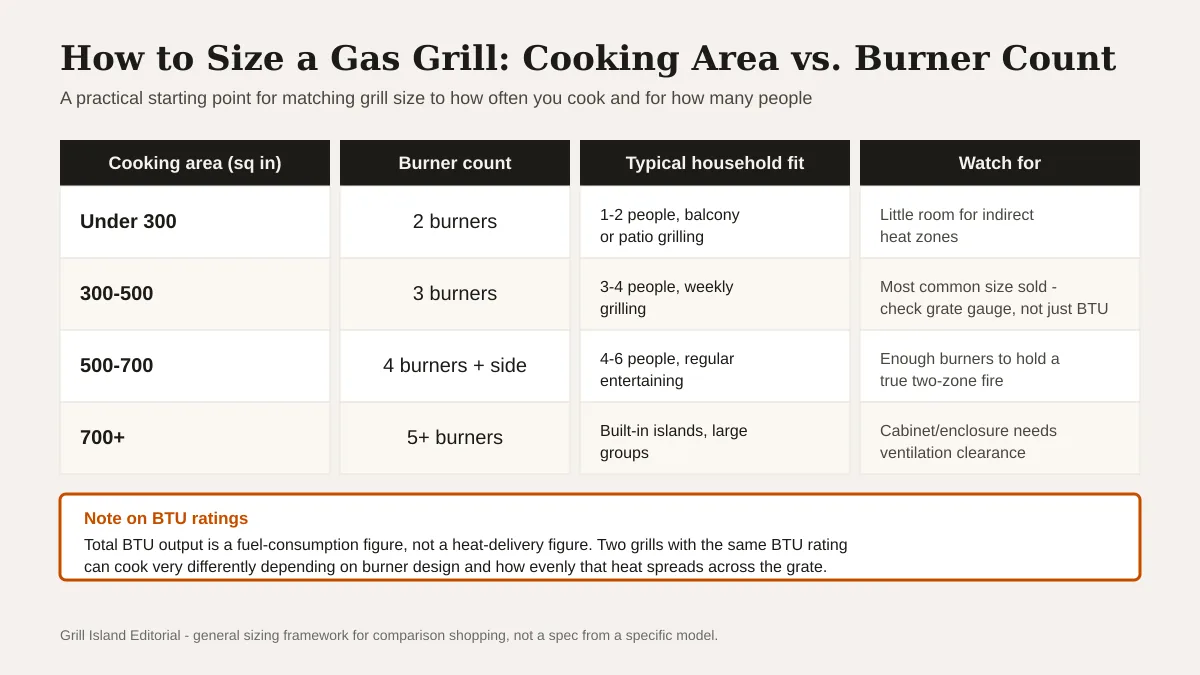
Beyond raw square inches, leave room for a two-zone fire: one area at high heat for searing, one area at lower (or no) heat for finishing without burning the outside before the inside cooks through. That’s a burner-layout question as much as a size question — see the next section.
Propane or Natural Gas: Which Fuel Fits Your Setup
Propane grills are portable and need zero installation; natural gas grills need a fixed gas line but never run out mid-cook. The right choice depends on your yard and how you use the grill, not on which fuel cooks “better” — both burn the same way once lit.
| Factor | Propane (LP) | Natural gas |
|---|---|---|
| Installation | None — connect the tank and go | Requires a licensed plumber to run a gas line |
| Portability | Fully portable, patio or tailgate | Fixed to one location near the hookup |
| Running out mid-cook | Possible — tanks need refill or swap | Not an issue on a piped supply |
| Ongoing cost | Pay per tank refill or exchange | Typically cheaper per hour of cooking, billed with your utility [A VERIFIER: local utility rate dependent] |
| Typical fit | Renters, movers, no gas line available | Permanent outdoor kitchens and built-in islands |
Most freestanding grills ship propane-ready, and many manufacturers sell a natural-gas conversion kit for the same model — worth checking before you assume you need to buy two different grills if your plans change later. Once you’ve found the fuel setup that fits your yard, sizing and materials matter more to your actual cooking experience than which fuel line feeds the burners.
Materials and Build Quality That Hold Up Outdoors
304 stainless steel resists rust longer than 430 stainless or painted carbon steel because of its higher chromium and nickel content — check the grade before you check the finish, since both can look identical in the showroom.
| Material | Corrosion resistance | Typical use |
|---|---|---|
| 304 stainless steel | High — higher chromium/nickel content | Premium built-ins, coastal/humid climates |
| 430 stainless steel | Moderate — can still surface-rust over time | Mid-range freestanding grills, exterior panels |
| Cast aluminum | High — doesn’t rust, can corrode/pit if uncoated | Firebox and burner housings |
| Painted carbon steel | Low once paint chips or scratches | Entry-level carts and side tables |
- Inspect hoses and connections for cracking, brittleness, or sharp bends before connecting the tank.
- Open the gas valve fully and brush a soapy-water solution on every connection — bubbling means a leak, and the grill should not be used until it’s fixed.
- Check burner tubes for insect or grease blockage, which causes uneven flame and flare-ups.
Source: U.S. Consumer Product Safety Commission, grill safety guidance (cpsc.gov, accessed July 2026).
Buy for how you will cook most weeks of the year, not for the one holiday cookout you host annually — food cooked on a grate sized and built for weekly use holds up better than gear bought for a single event.
Which Features Are Worth Paying For
A side burner and rotisserie burner earn their keep if you regularly cook multi-course meals outdoors; infrared sear burners and built-in lighting matter less if you mostly grill on weekends. Pay for the features that match your actual cooking habits, not the longest spec sheet.
If you mostly cook for one or two people, a small two-burner grill is easier to heat evenly than an oversized six-burner unit sitting mostly cold. A full outdoor kitchen build can get expensive fast, so consider starting with a quality freestanding grill and adding built-in components over a year or two rather than all at once.
- Side burner — worth it if you make sauces, sides, or sauté while the main course grills. Skip it if you always finish sides in the kitchen.
- Rotisserie burner + kit — worth it for whole chickens or roasts on a regular basis. Skip it if you rarely roast whole cuts.
- Infrared sear burner/station — worth it if steakhouse-style searing matters to you specifically; a well-designed standard burner can still sear well.
- Built-in lighting — worth it if you grill after dark often. A clip-on light does the same job for less if you don’t.
- Weather-resistant cover — worth it everywhere, including on covered patios; it’s the cheapest way to extend the life of any grill, regardless of material grade.
Area, burners, fuel, and material, in that order — that is how to choose a gas grill that fits your own cooking habits instead of a spec sheet built for someone else’s backyard.
If you’re still weighing fuel types beyond installation logistics, our full comparison of gas vs. charcoal flavor differences covers the cooking-result side of that decision in more depth.
Gas Grill Buying FAQ
What size gas grill do I need for a family of four?
For a household of four, look for 400-500 square inches of cooking area with at least three burners. That gives enough surface for a two-zone fire — one side for searing, one for finishing — without overbuying a grill sized for large group entertaining.
Is natural gas cheaper than propane for grilling?
Natural gas is generally billed at a lower cost per hour of cooking than propane tank refills, though the exact savings depend on local utility rates and how often you grill. The bigger cost is the one-time expense of running a gas line if you don’t already have one.
Which stainless steel grade holds up longest outdoors?
304 stainless steel is the better choice for long-term outdoor exposure because its higher chromium and nickel content resists rust more effectively than 430 stainless. Check the spec sheet for the grade — grills using 430 stainless or painted steel can look identical in a showroom but hold up differently over years outside.
How many burners do I actually need?
Two burners work for occasional grilling for one or two people. Three to four burners give you the independent heat zones needed for searing and indirect cooking at the same time, which is what most regular home cooks actually use day to day.
Do I need a side burner on a gas grill?
A side burner is worth it if you cook sauces, sides, or sautéed dishes outdoors while the main course grills. If you always prep sides in the kitchen, it’s an added cost that mostly goes unused — skip it and put the budget toward cooking area or build quality instead.
How do I check a gas grill for leaks before first use?
Open the propane valve fully, then brush a soapy-water solution over every hose connection. Bubbling at a connection point means a leak — tighten or replace that fitting and retest before lighting the grill. The CPSC recommends this check every time you reconnect or replace a tank.
- U.S. Consumer Product Safety Commission — grill safety and leak-check guidance, cpsc.gov (accessed July 2026).
- AmazingRibs.com — gas grill buying guide and BTU/heat-delivery testing notes (accessed July 2026).
Grill Island sells gas grills, built-in grills, and outdoor kitchen equipment in the US. Our guides are written from published manufacturer and industry buying-guide research and reviewed for accuracy before publishing.


